 by Peter F. Drucker –
To be effective is the job of the executive. “To effect” and “to execute” are, after all, near-synonyms. Whether he works in a business or in a hospital, in a government agency or in a labor union, in a university or in the army, the executive is, first of all, expected to get the right things done. And this is simply that he is expected to be effective.
Yet men of high effectiveness are conspicuous by their absence in executive jobs. High intelligence is common enough among executives. Imagination is far from rare. The level of knowledge tends to be high. But there seems to be little correlation between a man’s effectiveness and his intelligence, his imagination or his knowledge.
Brilliant men are often strikingly ineffectual; they fail to realize that the brilliant insight is not by itself achievement. They never have learned that insights become effectiveness only through hard systematic work.
Conversely, in every organization there are some highly effective plodders. While others rush around in the frenzy and busyness which very bright people so often confuse with “creativity,” the plodder puts one foot in front of the other and gets there first, like the tortoise in the old fable.
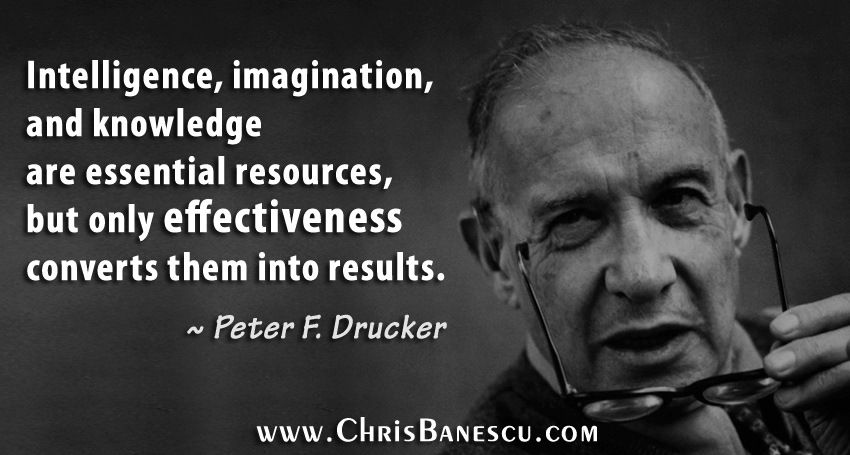
Intelligence, imagination, and knowledge are essential resources, but only effectiveness converts them into results. By themselves, they only set limits to what can be attained.
———————————————
Excerpts from Chapter 1 in The Effective Executive. (Minor formatting edits and bolding of phrases to emphasize key points made by Chris Banescu.)