Warning Signs of Power Corruption in Organizations

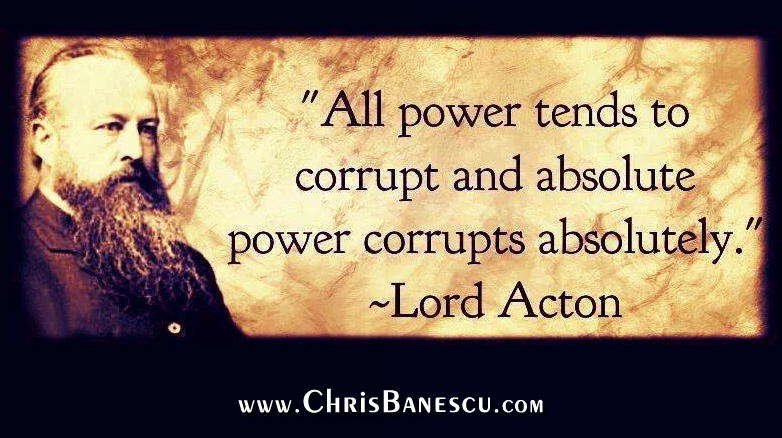
Power tends to corrupt, and absolute power corrupts absolutelyby Chris Banescu –
Power tends to corrupt, and absolute power corrupts absolutely. Great men are almost always bad men, even when they exercise influence and not authority: still more when you superadd the tendency or certainty of corruption by full authority. There is no worse heresy than the fact that the office sanctifies the holder of it. – Lord Acton

Lord Acton’s dictum, made in 1887, clearly warns us that the practice of wielding power and influence can corrode the character of leaders. History is replete with examples of individuals who wielded unchecked power and eroded not only their own integrity, but also the ethical and moral foundations of the organizations they led and brought them to catastrophe and ruin. This danger is true of all organizations including businesses, religious institutions, and governments.

Here is the risk inherent in leadership: The greater the leader’s power, wealth, authority, and influence, the more likely the leader could succumb to ethical lapses and moral failings. The risk increases if the organization has a culture that lacks financial or managerial transparency and accountability, has insufficient checks and balances on executive power, and discourages criticism from subordinates or members. When a leader with a poorly developed ethical or moral sense ends up leading an organization with a culture that prevents ethical self-examination, a slow but perfect storm starts to form that demands compromise from all levels of leadership and eventually leads to catastrophic consequences. [Read more…]
Key Characteristics of Great Leaders – Part II

Great Leaders Integrity, Honesty, Humility, Courageby Chris Banescu –
In this article I’m continuing with my review of the key characteristics of great leaders. Here are some additional qualities that embody superior leadership.

Great leaders surround themselves with greatness. They actively seek out the best possible people and hire them to fill all key positions within their organizations. Great leaders know that surrounding themselves with excellence is a direct reflection on their own character, abilities, and effectiveness as leaders. They understand that their own success and the success of their organizations depend mostly on hiring and promoting the best qualified, ethical, skilled, responsible, mature, and productive people and giving them the proper resources, authority, and freedom to do what’s needed for the long-term benefit of their companies. Great leaders do not feel threatened by anyone lower in the chain of command who’s smarter, better educated, more productive, or more popular than they are. They respect the greatness and unique abilities of the individuals they lead and encourage them to continually flourish and grow. [Read more…]

Truth in Organizations is Not a Matter of Opinion

Truth in Organizations, Truth in BusinessTelling the truth is too often overlooked in business. Truth is the catalyst that should inform all management decisions and actions. It’s the foundation on which trust and integrity rest. Truth is the critical prerequisite that enables management and employees to make ethical decisions in the day-to-day activities of an organization.

Now when I speak of “truth” I mean the objective reality of our lives that we can all categorically agree with. This includes facts and information that cannot be disputed and are universally true whether or not someone chooses to acknowledge them. Some examples include: two plus two always equals four, water is necessary to sustain life, man has landed on the moon, companies must be profitable to remain in business, in a vacuum light travels at precisely 186,282.397 miles per second, and only 0.037% of our atmosphere is made up of carbon dioxide.
[Read more…]

Some Employees Are More Equal Than Others

Some Employees Are More Equal Than Othersby Chris Banescu –
When I was younger I used to believe that getting a good education and working hard would offer me a stable life. I learned real quick that many companies don’t reward hard work anymore – at least not like I thought they should.

I believe in hard work. I think people should be rewarded on what they produce. But all too often the wrong people get promoted. Employees get preferential treatment and enjoy more benefits and opportunities as long as they don’t make any waves, toe the organizational line, and always support their bosses; no matter how incompetent, hypocritical, or abusive they are.

When we first come across such a dysfunctional work environment (especially early in our career), we are not sure what to make of it. We recognize that such preferential treatment of less qualified employees is neither ethical nor fair, but we don’t know how to handle it. [Read more…]