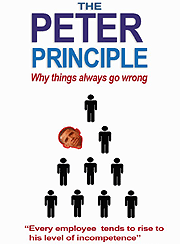
Do the Incompetent Rise to the Top? Peter Principle Revisited

Peter Principle Incompetence Rises to the Top by Ronald E. Riggio, Ph.D. –
How and why do incompetent people rise to the top?

Why are there so many incompetent leaders? Is your boss less than competent? How about that department head in accounting or HR that doesn’t know his/her job? How in the world do incompetent people rise to the top in many organizations? Here are the reasons:

We Don’t Do a Good Job of Selecting Leaders. We simply don’t invest the time or resources needed to select the best people for jobs. Time and time again, we take hiring shortcuts. We interview in a haphazard way, and select the person who appears best in the interview. The problem is that often the best performer in the interview is one of the least competent workers (they’re so good in the interview because they get so much practice, because they are often fired!). [Read more…]

How to Lead With Purpose

How to Lead With Purposeby Marla Tabaka –
The purpose-driven company is led by someone who has a reliable inner compass guiding them. John Baldoni asks: What’s your direction?

Can you describe the purpose of your business in a single sentence? Do you—and does every single person who is connected with your organization—have a reason to believe in that mission? Internationally recognized leadership educator John Baldoni believes that when an organization succeeds, it is because everyone involved knows precisely what they do—and why they do it. Even in start-up mode, an entrepreneur needs to constantly consider his or her mission and purpose to ensure growth and success. I recently spoke with Baldoni, the author of Lead with Purpose: Giving Your Organization a Reason to Believe in Itself, about the the defining qualities and responsibilities of one who leads with purpose. [Read more…]

Steve Jobs on Work, Passion, Life, and Death

Steve Jobs work passion life death by Chris Banescu –
As the world mourns the passing away of Steven P. Jobs, the visionary entrepreneur and creative genius behind Apple, it’s important to remember some timeless insights and essential lessons for life that he talked about. I was reminded of the maturity and wisdom of his message while watching a video of an inspiring and thoughtful Commencement address he delivered to the Stanford University graduating class on June 12, 2005. There are several notable comments and sage advice I highlight below. They have helped and reassured me, I hope they will help you also.

Steve Jobs on the importance of dealing with hardships, finding work that you are passionate about, loving what you do, and following your vocation:

“I’m pretty sure none of this would have happened if I hadn’t been fired from Apple. It was awful tasting medicine, but I guess the patient needed it. Sometimes life hits you in the head with a brick. Don’t lose faith. I’m convinced that the only thing that kept me going was that I loved what I did. You’ve got to find what you love. And that is as true for your work as it is for your lovers.

Your work is going to fill a large part of your life, and the only way to be truly satisfied is to do what you believe is great work. And the only way to do great work is to love what you do. If you haven’t found it yet, keep looking. Don’t settle. As with all matters of the heart, you’ll know when you find it. And, like any great relationship, it just gets better and better as the years roll on. So keep looking until you find it. Don’t settle.”

[Read more…]

Lessons in Leadership from an Airline Captain

Captain Chesley SullenbergerIt is often in times of crisis and life-threatening emergencies that the real character of an individual is made manifest. The contrasts between the leadership of an American airline captain and that of our current president offer us an opportunity for personal and societal reflection. The differences could not be more striking.

On January 15, 2009, US Airways Flight 1549 took off from New York’s LaGuardia Airport with 155 passengers and crew on board. In the cockpit of the Airbus A-320 twin-engine aircraft were Captain Chesley Sullenberger and First Officer Jeff Skiles. With First Officer Skiles at the controls, the airplane climbed away from the airport. As flight 1549 approached an altitude of 3,000 feet, the plane struck a flock of geese and instantly lost thrust in both engines. At once Captain Sullenberger realized that both engines were failing and imminent danger awaited the passengers and crew. He quickly put his hand on the side stick, called out “my airplane” (at 3:53 in the video), and took over control of the aircraft from First Officer Skiles. There was no panic, no fuss, no paralysis, no moment of indecision — just calm, competent leadership and confident action. [Read more…]

What If You Work for a Bad Leader?

Bad Leader Bad Bossby Michael Hyatt –
About once a week I get an email from someone who wants to know how to work for a bad leader. Maybe their boss is a jerk. Maybe he is just incompetent. Regardless, they are not quite sure how to lead well in this kind of situation.

Though I eventually became a CEO, I spent most of my corporate years in middle management. I had my share of bad bosses. A few were jerks. I imagined myself quitting or at least giving them a good tongue-lashing. Others were incompetent. I wanted to pull my hair out or rat them out to their boss.

Fortunately, I didn’t do any of these things, though I was often tempted. And, I’m glad I didn’t. Each of these bad bosses served to make me a better leader. You can learn from positive role models. Sometimes you can learn even more from negative ones. [Read more…]

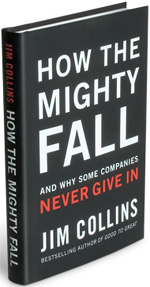
How the Mighty Fall: A Primer on the Warning Signs

How the Mighty FallBy Jim Collins –
The author of Good to Great on how to spot the subtle signs that your successful company is actually on course to sputter—and how to reverse the slide before it’s too late.

I pondered and puzzled and finally settled upon the question: Is America renewing its greatness, or is America dangerously on the cusp of falling from great to good? While I intended the question to be rhetorical (I believe America carries a responsibility to continuously renew itself, and it has met that responsibility throughout its history), the West Point gathering nonetheless erupted into an intense debate. Half of the participants argued that America stands as strong as ever, while the other half contended that America teeters on the edge of decline.

History shows, repeatedly, that the mighty can fall. The Egyptian Old Kingdom, the Chou Dynasty, the Hittite Empire—all fell. Athens fell. Rome fell. Even Britain, which stood a century before as a global superpower, saw its position erode. Is that the U.S.’s fate? Or will America always find a way to meet Lincoln’s challenge to be the last best hope of Earth?

At a break, the chief executive of one of America’s most successful companies pulled me aside. “I’ve been thinking about your question in the context of my company all morning,” he said. “We’ve had tremendous success in recent years, and I worry about that. So what I want to know is: How would you know?” [Read more…]

Entrepreneurs: Leading the Way Out

Entrepreneurs Lead by Greg Pesci –
Entrepreneurs, free to pursue their economic dreams, built America! They are, and always have been, its creators of jobs, growth, and wealth.

In 1831, Alexis de Tocqueville wrote in Democracy in America:“It may be said that, in the United States, there is no limit to the inventiveness of man to discover the ways of increasing wealth and to satisfy the public’s needs.” He continued, “the primary reason for [America’s] rapid progress, their strength and greatness is their bold approach to industrial undertakings.” What impressed De Tocqueville most about business in America was “not so much the marvelous grandeur of some undertaking as the innumerable multitude of small ones.”

Data from the Census Bureau (Business Dynamics Statistics) demonstrate that since 1977 American entrepreneurs in firms less than five years old have been responsible for literally all the net job creation in this country. For more than 30 years, new companies have led job creation in America. Recently, Carl J. Schramm of the Kauffman Foundation stated, “new and young companies and the entrepreneurs that create them are the engines of job creation and eventual recovery.” With 9.8 percent unemployment, if we want to create jobs in America we need to free up entrepreneurs and not burden them with increased taxes or regulation. [Read more…]