Warning Signs of Power Corruption in Organizations

Power tends to corrupt, and absolute power corrupts absolutelyby Chris Banescu –
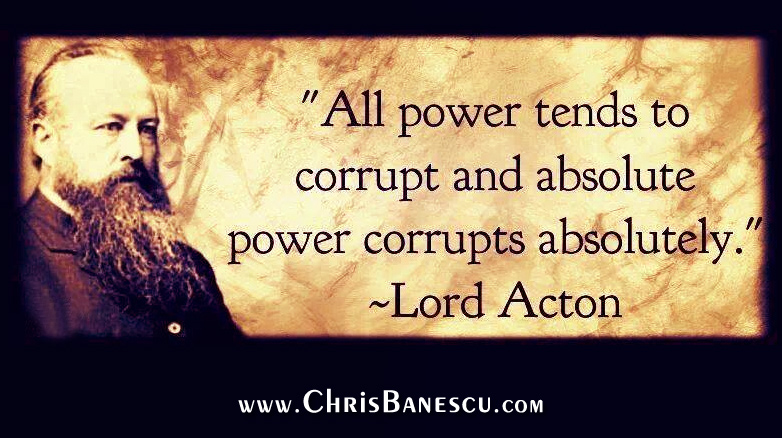
Power tends to corrupt, and absolute power corrupts absolutely. Great men are almost always bad men, even when they exercise influence and not authority: still more when you superadd the tendency or certainty of corruption by full authority. There is no worse heresy than the fact that the office sanctifies the holder of it. – Lord Acton

Lord Acton’s dictum, made in 1887, clearly warns us that the practice of wielding power and influence can corrode the character of leaders. History is replete with examples of individuals who wielded unchecked power and eroded not only their own integrity, but also the ethical and moral foundations of the organizations they led and brought them to catastrophe and ruin. This danger is true of all organizations including businesses, religious institutions, and governments.

Here is the risk inherent in leadership: The greater the leader’s power, wealth, authority, and influence, the more likely the leader could succumb to ethical lapses and moral failings. The risk increases if the organization has a culture that lacks financial or managerial transparency and accountability, has insufficient checks and balances on executive power, and discourages criticism from subordinates or members. When a leader with a poorly developed ethical or moral sense ends up leading an organization with a culture that prevents ethical self-examination, a slow but perfect storm starts to form that demands compromise from all levels of leadership and eventually leads to catastrophic consequences. [Read more…]

The Three Most Important Rules in Business

Success - The Three Most Important Rules in Businessby Chris Banescu –
From my years of experience working for different companies and teaching various graduate business courses, I developed three rules that management must practice in order to achieve long-term profitability and success. Follow these rules, and a business can remain healthy and prosper. Ignore them, and failure is virtually guaranteed in the long term.

Rule #1 – Always Meet and Exceed Customer Expectations.
Meeting and exceeding customer expectations is the most important but often overlooked rule of business. The only way a company stays in business is if the customer is satisfied with its product or service. This generates profit, builds long-term stability, and meets the challenge of competitors. Meeting expectations should be considered the baseline for company performance. Exceeding expectations should be the ultimate goal. [Read more…]

‘Atlas Shrugged’: From Fiction to Fact in 52 Years

The Wall Street Journal | by Stephen Moore| January 9, 2009

Some years ago when I worked at the libertarian Cato Institute, we used to label any new hire who had not yet read “Atlas Shrugged” a “virgin.” Being conversant in Ayn Rand’s classic novel about the economic carnage caused by big government run amok was practically a job requirement. If only “Atlas” were required reading for every member of Congress and political appointee in the Obama administration. I’m confident that we’d get out of the current financial mess a lot faster. [Read more…]

Managing for Long-Term Success and Profitability

Business Success and Profitability Long-Termby Chris Banescu –
Good management has nothing to do with short-term successes and the management elixirs that allegedly led to them. This seemingly banal insight results from a long-term, historical perspective like [Peter] Drucker’s. It cannot be achieved by judgments based on quarterly results, but rather emerges from a deeply rooted understanding of the durable, unclouded by short-term spectacular success stories. Not the momentary “how” is important, but rather the seminal “why.” (Herman Simon, Management Beyond the Day)

Despite well-established management principles that require a long-term perspective be used when evaluating all business decisions and the countless organizational failures and disasters that demonstrate the consequences of ignoring such strategic thinking, many corporations continue to repeat those same mistakes and seemingly fail to learn their lessons. This may be due to the pressures placed on companies to be “profitable” for the next quarter that motivate senior executives to quickly maximize share prices while ignoring the potential negative effects to the long-term profitability, value, and survivability of an organization. Another explanation for this dysfunctional approach may be the flawed compensation systems and executive contracts that reward management for short-sighted profitability decisions without demanding accountability for the long-term organizational profitability and taking into consideration the impact on the long-term value and competitive position of a company. [Read more…]

Key Characteristics of Great Leaders – Part II

Great Leaders Integrity, Honesty, Humility, Courageby Chris Banescu –
In this article I’m continuing with my review of the key characteristics of great leaders. Here are some additional qualities that embody superior leadership.

Great leaders surround themselves with greatness. They actively seek out the best possible people and hire them to fill all key positions within their organizations. Great leaders know that surrounding themselves with excellence is a direct reflection on their own character, abilities, and effectiveness as leaders. They understand that their own success and the success of their organizations depend mostly on hiring and promoting the best qualified, ethical, skilled, responsible, mature, and productive people and giving them the proper resources, authority, and freedom to do what’s needed for the long-term benefit of their companies. Great leaders do not feel threatened by anyone lower in the chain of command who’s smarter, better educated, more productive, or more popular than they are. They respect the greatness and unique abilities of the individuals they lead and encourage them to continually flourish and grow. [Read more…]

Breaking Through

Inc.com | by Mike Hofman | January 2008
How companies just like yours mushroomed into powerhouses in their industries. A conversation with Keith R. McFarland.

How do you create a breakthrough company? Where do you start?
First, I’d say that it’s not about being in a hot, sexy market. It’s not about having the coolest, hippest product. We came up with an index of companies that grew to a certain level both in terms of their annual revenue and in terms of their financial performance, compared with the rest of their industry. [Read more…]

Key Characteristics of Great Leaders – Part I

Great Leaders characteristicsby Chris Banescu –
What are some key characteristics of a great leader? While many books and countless articles have been written about this subject, we continue to witness a significant shortage of great leaders in many companies and institutions. Here are some essential traits and skills that great leaders must possess.

Great leaders are people persons. They must like being around people, be comfortable talking to and listening to people, and know how to relate to them. Great leaders must know how to communicate with their employees, speak their language, and not talk down to them. This is essential. Anyone who is not comfortable being around people, or exhibits anti-social or narcissistic behavior, should not lead or be in charge of anyone. Bullies, sycophants, and loners never make great leaders, regardless of their level of intelligence, education, and capability.
[Read more…]