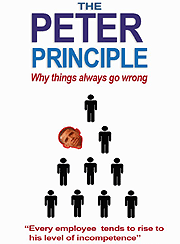
Do the Incompetent Rise to the Top? Peter Principle Revisited

Peter Principle Incompetence Rises to the Top by Ronald E. Riggio, Ph.D. –
How and why do incompetent people rise to the top?

Why are there so many incompetent leaders? Is your boss less than competent? How about that department head in accounting or HR that doesn’t know his/her job? How in the world do incompetent people rise to the top in many organizations? Here are the reasons:

We Don’t Do a Good Job of Selecting Leaders. We simply don’t invest the time or resources needed to select the best people for jobs. Time and time again, we take hiring shortcuts. We interview in a haphazard way, and select the person who appears best in the interview. The problem is that often the best performer in the interview is one of the least competent workers (they’re so good in the interview because they get so much practice, because they are often fired!). [Read more…]
How To Make Companies Think Long-Term

Harvard Business Review logo by Roger Martin –

In my latest book, Fixing the Game: Bubbles, Crashes, and What Capitalism Can Learn from the NFL, I wrote about the negative impact of executive stock-based compensation on corporate short-termism. Eliminating stock-based compensation would help reduce the incentive for executive leadership to focus on the short term. But there is a residual problem which has long frustrated me. The answer finally popped into my brain (funny how that works). As usual, the solution won’t be easy to pull off (but that has never stopped me).

The residual problem I’m talking about is corporate short-termism. Many companies face quarterly or even more immediate pressure from their shareholders (increasingly made up of hedge funds, program traders, and day traders) to deliver short-term performance. Worried that short-term-oriented arbitrageurs will put their company in play and short-term-oriented shareholders will gain majority or effective control of the company, ending their ability to steer the long-term trajectory of the company, they focus on making short-term decisions to protect their positions. The paradoxical result is that they never get around to taking those long-term-oriented decisions. [Read more…]

Business Schools Add Courses On Ethics, But Are Graduates More Ethical?

Business Schools ethics MBA by Ben Schiller –
Post-financial meltdown, business schools are trying to make their graduates more responsible. But does taking one class on ethics work, or does a new ethical model need to permeate the curriculum?

Many industry watchers saw business schools as contributing factors in the financial crisis, arguing that, by failing to challenge orthodoxies, and overlooking “socially useless” activities, they helped create conditions for collapse. That nearly every relevant banker, regulator, and politician was an MBA graduate helped make the case.

But what about now? Have b-schools changed?

Yes, and no, according to a survey of how schools are teaching social, environmental, and ethical topics.[Read more…]

Dealing with Your Incompetent Boss

Dealing with Incompetent Bossby Amy Gallo –

Everyone complains about his or her boss from time to time. In fact, some consider it a national workplace pastime. But there’s a difference between everyday griping and stressful frustration, just as there is a clear distinction between a manager with a few flaws and one who is incompetent. Dealing with the latter can be anguishing and taxing. But with the right mindset and a few practical tools, you can not only survive but flourish.

What the Experts Say
“Most people have had experience with someone who is incompetent, or at least unhelpful,” says Annie McKee, founder of the Teleos Leadership Institute and co-author of Becoming a Resonant Leader: Develop Your Emotional Intelligence, Renew Your Relationships, Sustain Your Effectiveness. Ineptitude in managers is unfortunately common. McKee says that’s because too many companies promote people for the wrong reasons. [Read more…]

The Superiority of School Vouchers Demonstrated

School Vouchers by Gary Jason –
The failure of the American K-12 public school system has been obvious for decades. Some of us fossils can recall the public uproar that accompanied the release of the report “A Nation at Risk” back in 1987, documenting the mediocre at best, disastrously bad at worst performance of the nation’s public schools.

The public school special interest groups (the PSSIGs) — that is, public school administrators, education department professors, “labor studies” professors, textbook publishers, and most notoriously teachers unions and their members — managed to turn the outrage into support for jacking up spending.

Over the last quarter-century, we have nearly doubled our national per capita spending — we now outspend per capita for K-12 education every other nation on Earth but one. But our national student scores have remained flat, while internationally, we have dropped in ranking among developed nations from 14th during the 1970s down to 24th place today. [Read more…]

How P&G Tripled Its Innovation Success Rate

Tide logo success by Bruce Brown and Scott D. Anthony –
Back in 2000 the prospects for Procter & Gamble’s Tide, the biggest brand in the company’s fabric and household care division, seemed limited. The laundry detergent had been around for more than 50 years and still dominated its core markets, but it was no longer growing fast enough to support P&G’s needs. A decade later Tide’s revenues have nearly doubled, helping push annual division revenues from $12 billion to almost $24 billion. The brand is surging in emerging markets, and its iconic bull’s-eye logo is turning up on an array of new products and even new businesses, from instant clothes fresheners to neighborhood dry cleaners.

This isn’t accidental. It’s the result of a strategic effort by P&G over the past decade to systematize innovation and growth.

To understand P&G’s strategy, we need to go back more than a century to the sources of its inspiration—Thomas Edison and Henry Ford. In the 1870s Edison created the world’s first industrial research lab, Menlo Park, which gave rise to the technologies behind the modern electric-power and motion-picture industries. [Read more…]

What If You Work for a Bad Leader?

Bad Leader Bad Bossby Michael Hyatt –
About once a week I get an email from someone who wants to know how to work for a bad leader. Maybe their boss is a jerk. Maybe he is just incompetent. Regardless, they are not quite sure how to lead well in this kind of situation.

Though I eventually became a CEO, I spent most of my corporate years in middle management. I had my share of bad bosses. A few were jerks. I imagined myself quitting or at least giving them a good tongue-lashing. Others were incompetent. I wanted to pull my hair out or rat them out to their boss.

Fortunately, I didn’t do any of these things, though I was often tempted. And, I’m glad I didn’t. Each of these bad bosses served to make me a better leader. You can learn from positive role models. Sometimes you can learn even more from negative ones. [Read more…]