A Little Less Conversation

A Little Less Conversation
Inc.com | by Joel Spolsky | 2/1/2010
Have you ever invited employees to a meeting just so they wouldn’t feel left out? If so, you may be an overcommunicator.

When was the last time you scheduled a meeting and invited eight people instead of the three people who really needed to be there simply because you didn’t want anyone to feel left out?

When was the last time you sent a companywide e-mail that said something like, “Hey, attention coffee drinkers: If you finish the pot, make another!” even though there is actually only one person who violates this rule (and she’s your co-founder)? [Read more…]

The Way I Work: Kathy Ireland

Inc.com | As told to Liz Welch | 12/1/2009

Former supermodel Kathy Ireland founded a little company to make products for “busy moms” like herself. Now, with revenue of $1.4 billion, she’s busier than ever.

When she was in her 20s and a model, Kathy Ireland says, her job description was “Shut up and pose.” So it irks her when anyone suggests that the 46-year-old CEO and chief designer of Kathy Ireland Worldwide is merely the face of her $1.4 billion business. Ireland, who launched the Los Angeles–based company in 1993 and is the majority shareholder, began by creating a line of socks and parlayed that into a large licensing deal with Kmart that lasted until 2003. Now she puts her stamp on more than 15,000 products — including scented candles, dining room sets, porcelain dishes, wood flooring, skin care products, and swimsuits. [Read more…]

Five Attributes Of Enduring Family Businesses

Five Attributes Of Enduring Family Businessesby C. Caspar, A. Dias, H. Elstrodt
The keys to long-term success are professional management and keeping the family committed to and capable of carrying on as the owner. Family businesses are an often overlooked form of ownership. Yet they are all around us–from neighborhood mom-and-pop stores and the millions of small and midsize companies that underpin many economies to household names such as BMW, Samsung and Wal-Mart Stores.

One-third of all companies in the S&P 500 index and 40% of the 250 largest companies in France and Germany are defined as family businesses, meaning that a family owns a significant share and can influence important decisions, particularly the election of the chairman and CEO. [Read more…]

Focus Is The New Key To Work-Life Balance

Focus required for success and self-improvementForbes | by Joan Gurvis | Nov. 25, 2009

If having a balanced life was elusive in the fast-paced good times, it can seem impossible in the fast-paced tough times.

The pressures on leaders are huge. Distractions are everywhere. As work demands grow, our inclination is to continue to try to do more things more quickly, to fit everything in. We push ourselves, our co-workers and our employees to keep up the intense pace, but in so doing, we leave ourselves without adequate time to stop, reflect and focus. [Read more…]

How to Liberate an Economy

Entrepreneurs understand the importance of freedom in the workplace.
City Journal | by Guy Sorman | October 21, 2009

Brian Carney and Isaac Getz’s Freedom, Inc. is a timely book. It’s also countercyclical and somewhat counterintuitive. After all, most of today’s writing about economics and business is haunted by the current crisis: nearly every author and commentator expects that either more or less government intervention will bring the economy out of its difficulties. But Carney and Getz remind us that without well-managed enterprises, there would be no economy at all.

Crisis or no crisis, the engine of economic growth has always been, and will always remain, entrepreneurs. Nations without entrepreneurs—whether they drive them out with excessive taxes and regulations, or in more extreme cases, suppress, exile, or kill them—never reach prosperity. One can often ascertain the condition of a nation’s economy by assessing the cultural, legal, fiscal, and social status of its entrepreneurial class. [Read more…]

John Mackey of Whole Foods on Hiring Leaders

John Mackey of Whole Foods on Hiring LeadersInc.com | John Mackey Interview | July 2009

Q: What traits should I look for when hiring for a leadership position?

A: My philosophy about this has definitely evolved over the years. I understand people a lot better today than I did 30 years ago. Back then, I was more impressed with people who were very articulate. In many companies, the person who talks the best usually gets the job. I got snowed by a few of those people over the years. I still think communication is important, but I don’t think there’s always a correlation between being a great communicator and other virtues that make for a great leader. [Read more…]

Warning Signs of Power Corruption in Organizations

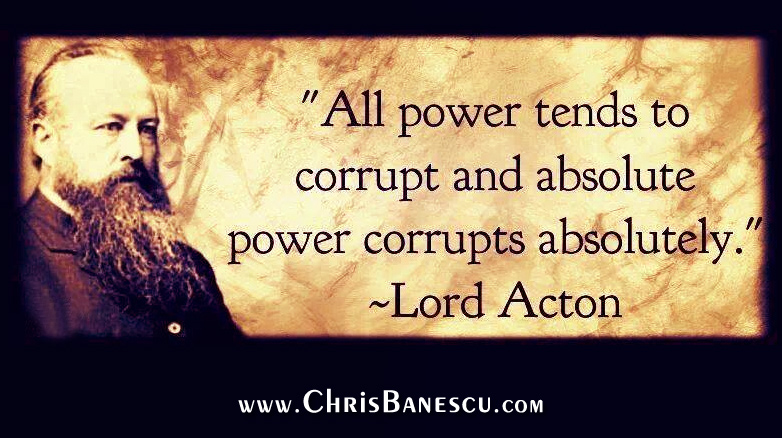
Power tends to corrupt, and absolute power corrupts absolutelyby Chris Banescu –
Power tends to corrupt, and absolute power corrupts absolutely. Great men are almost always bad men, even when they exercise influence and not authority: still more when you superadd the tendency or certainty of corruption by full authority. There is no worse heresy than the fact that the office sanctifies the holder of it. – Lord Acton

Lord Acton’s dictum, made in 1887, clearly warns us that the practice of wielding power and influence can corrode the character of leaders. History is replete with examples of individuals who wielded unchecked power and eroded not only their own integrity, but also the ethical and moral foundations of the organizations they led and brought them to catastrophe and ruin. This danger is true of all organizations including businesses, religious institutions, and governments.

Here is the risk inherent in leadership: The greater the leader’s power, wealth, authority, and influence, the more likely the leader could succumb to ethical lapses and moral failings. The risk increases if the organization has a culture that lacks financial or managerial transparency and accountability, has insufficient checks and balances on executive power, and discourages criticism from subordinates or members. When a leader with a poorly developed ethical or moral sense ends up leading an organization with a culture that prevents ethical self-examination, a slow but perfect storm starts to form that demands compromise from all levels of leadership and eventually leads to catastrophic consequences. [Read more…]