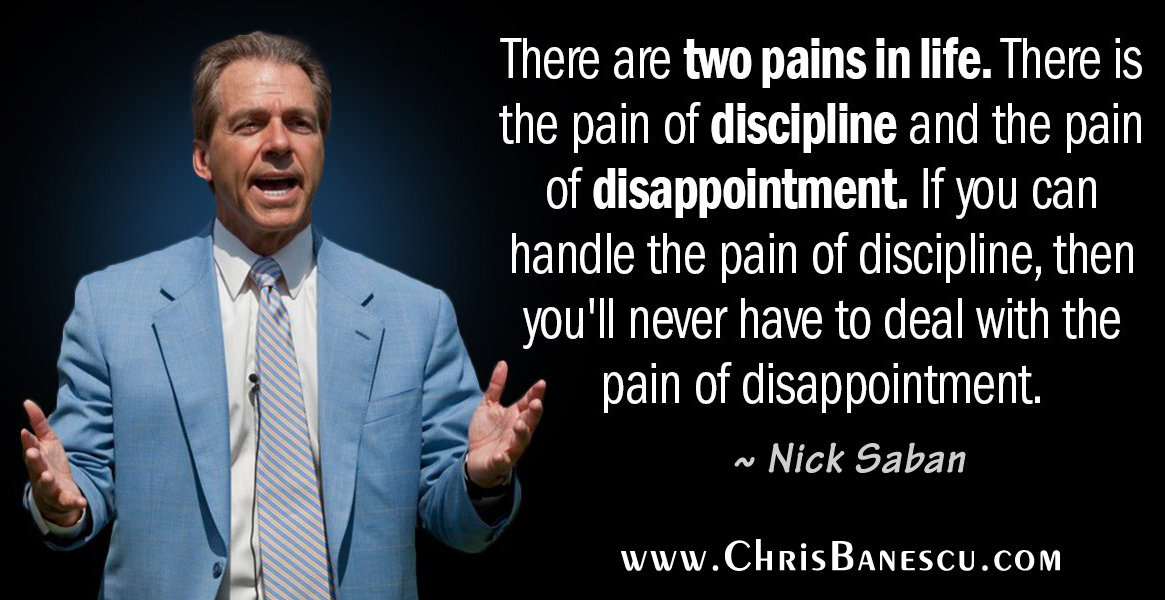
Pain of Discipline vs Pain of Disappointment

Pain of Discipline vs Pain of Disappointmentby Chris Banescu –
“There are two pains in life. There is the pain of discipline and the pain of disappointment. If you can handle the pain of discipline, then you’ll never have to deal with the pain of disappointment.” ~ Nick Saban

We all pay a price for the lack of discipline. Whether it’s our physical or mental health, spiritual well-being, character, family life, career situation, financial status, friendships, or business condition, we always suffer if we don’t do the essential work to either improve, adapt, or deal with the changing circumstances of our life. The longer we avoid consistently doing the right things for ourselves, our families, and/or businesses, the worse things will get. We will feel the inevitable physical and psychological pains that arise when we let things slide and refuse to do the daily necessary work. [Read more…]

Esri: Solid Revenues, Conservative and Systematic Growth, No Layoffs, No Downsizing

Esri: Solid Revenues, Conservative and Systematic Growth, No Layoffs, No Downsizingby Chris Banescu –
“We have 9,000 employees worldwide and $912 million n revenue. In our 43 years, we have never missed a quarter. We’ve never had any layoffs; we’ve never had any downsizing. It’s just been very conservative, systematic growth.” ~ Jack Dangermond

A few years ago Inc.com magazine interviewed Jack Dangermond the co-founder of Esri, a global corporation that supplies geographic information system software, web GIS, and geodatabase management applications. Dangermond highlighted the company’s stellar and systematic growth despite its conservative management style and lack of any layoffs in its 43 years of operation. [Read more…]

Empirical Creativity – An Important Tool for Successful Innovation

Empirical Creativity – An Important Tool for Successful Innovationby Chris Banescu –

In the book Great by Choice, authors Jim Collins and Morten T. Hansen set out to discover why some companies thrive in uncertain and chaotic times while others do not. Their extensive research identified what they named “10Xers“, businesses that didn’t just get by or became successful, but “truly thrived” beating other companies in their industry by “at least 10 times.”

Collins and Hansen set out to find enterprises that (1) sustained spectacular results for 15+ years relative to their industries and the market, (2) achieved results in turbulent and uncertain times, and (3) began their rise to greatness while being in a position of vulnerability.

Out of the 20,400 companies they initially began reviewing, they discovered just seven 10Xers (10X businesses) who fit their stringent performance characteristics.

The authors’ found that all 10Xers displayed the following behaviors: fanatic discipline, empirical creativity, and productive paranoia, all animated by “Level 5 ambition.” [Read more…]

How to Reduce Organizational Bureaucratization and Keep Executive Egos in Check

How to Reduce Organizational Bureaucratization and Keep Executive Egos in Checkby Chris Banescu –
In his groundbreaking book, Up the Organization: How to Stop the Corporation from Stifling People and Strangling Profits, Robert Townsend, unconventional business executive and former CEO of Avis Rent-a-Car, provides us with witty and practical advice on how to tackle misguided organizational processes and attitudes that stifle people and undermine profitability.

Townsend despised the constant organizational push by management towards additional bureaucratic processes and cumbersome institutional procedures that increased in size and complexity as a company grew. He also offered smart suggestions on how to keep the executives’ egos in check.

His first proposal on dealing with the bureaucratic danger is to make the CEO the initial guinea pig for institutional experimentation. Before anyone else in the company is forced to follow any new process or procedure, or fill out a new form or questionnaire, the chief executive must complete it in full first. Townsend surmised this approach alone would “kill a lot of bad ideas early.” [Read more…]

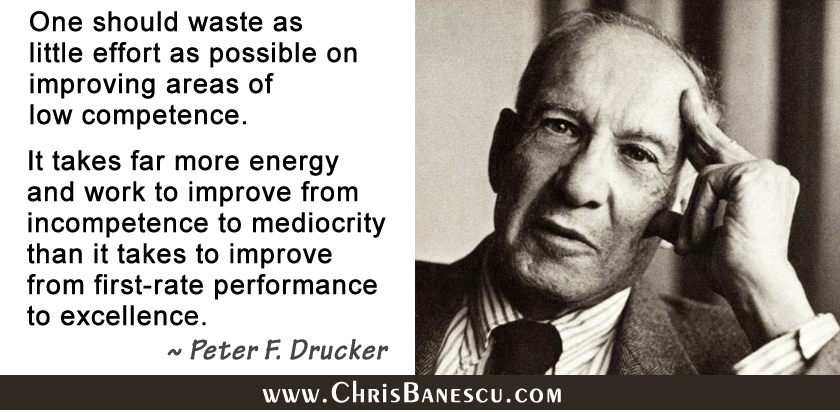
Focus on Your Strengths, Improve First-Rate Performance to Excellence

Focus on Your Strengths, Improve First-Rate Performance to Excellence“We all have a vast number of areas in which we have no talent or skill and little change of becoming even mediocre. In those areas a person –and especially a knowledge worker– should not take on work, jobs, and assignments.

One should waste as little effort as possible on improving areas of low competence. It takes far more energy and work to improve from incompetence to mediocrity than it takes to improve from first-rate performance to excellence.

And yet most people –especially most teachers and most organizations– concentrate on making incompetent performers into mediocre ones. Energy, resources, and time should go instead into making a competent person into a star performer.” ~ Peter F. Drucker

Rewards and Recognition Programs – Guiding Principles and Key Characteristics

Rewards and Recognition Programs - Guiding Principles and Key Characteristicsby Chris Banescu –
There are four guiding principles that leaders must consider when leading their employees. All rewards and recognition programs should be: personalized, noteworthy, meaningful, and motivating. This raises the bar on organizational performance, helps motivate employees, promotes and strengthens employee engagement, and nurtures healthy and constructive competition based on value-creation and operational excellence.

“The right total rewards system – a blend of monetary and nonmonetary rewards offered to employees – can generate valuable business results.” – Robert L. Heneman, Ph.D.

“[Think about] actions that are meaningful to [the employee] versus what’s meaningful to the giver.” … “We tend to give appreciation in ways that are meaningful to us, but if [the recipients] think it’s not authentic, it can create damage and make them think you’re trying to manipulate them.” – Paul E. White, Ph.D. [Read more…]

Rewards and Recognition Required to Motivate and Retain Employees

Rewards and Recognition Required to Motivate and Retain Employeesby Chris Banescu –
Companies and organizations must reward and recognize their employees in order to succeed and insure that they continue to be engaged, motivated, happy, and productive.

It is not just rewards or just recognition. It is not an either/or proposition. It’s also not rewards versus recognition. One does not have priority over the other.

It is rewards AND recognition. Why? Because it’s ethical, fair, and right, and it works!

Both are required in order to justly compensate, effectively lead, capitalistically reward, and ethically motivate and recognize your employees. Anything less will never be sufficient to attract and retain the talent necessary to insure the long-term success, profitability, and prosperity of any enterprise. [Read more…]