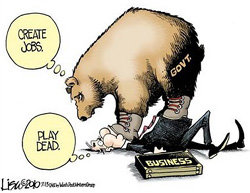
Job Creation Is No Mystery

Job Creation Business Economy Not Government by Tom McClintock –
The government’s continuing failure to address our nation’s gut-wrenching unemployment stems from a fundamental disagreement over how jobs are created in the first place.

We are now in the third year of policies predicated on the assumption that government spending creates jobs.

We have squandered three years and trillions of dollars of the nation’s wealth on such policies, and they have not worked because they cannot work.

Government cannot inject a single dollar into the economy until it has first taken that same dollar out of the economy. [Read more…]

Innovating in a Culture of Convergence

Innovation Product Design by Michelle Greenwald –
How exactly do we define innovation? While it’s probably the most overused term in business today, innovation is not a fad. It’s not even new. What differentiates a smart innovation—and makes it worth writing about—is that it has the capability of moving a business forward in ways that can result in more customers, more sales, more brand loyalty, more good will, or some combination of those effects. Smart innovation is capable of providing a company with competitive advantage. Innovations are smart when they are not just inventions for innovation’s sake, just to be new and different; rather they provide a strategic benefit.

Innovation has always been relevant because it aims to satisfy unmet consumer and business needs; as the new-product development time-to-market continues to shrink and product life cycles get shorter and shorter, the term will become even more relevant. What qualifies as an innovation, in my mind, is a product, service, aspect, or feature that is new, different, surprising, clever, fresh, attention-getting, challenging of conventional ways things are done, and is an obvious improvement on “what’s out there” in that particular product category and geographical area. [Read more…]

Do the Incompetent Rise to the Top? Peter Principle Revisited

Peter Principle Incompetence Rises to the Top by Ronald E. Riggio, Ph.D. –
How and why do incompetent people rise to the top?

Why are there so many incompetent leaders? Is your boss less than competent? How about that department head in accounting or HR that doesn’t know his/her job? How in the world do incompetent people rise to the top in many organizations? Here are the reasons:

We Don’t Do a Good Job of Selecting Leaders. We simply don’t invest the time or resources needed to select the best people for jobs. Time and time again, we take hiring shortcuts. We interview in a haphazard way, and select the person who appears best in the interview. The problem is that often the best performer in the interview is one of the least competent workers (they’re so good in the interview because they get so much practice, because they are often fired!). [Read more…]

Dwolla – New Payment System Sidesteps Credit Cards

Dwolla - New Payment Systemby Alyson Shontell –
There’s a tiny 12-person startup churning out of Des Moines, Iowa.

Dwolla was founded by 28-year-old Ben Milne; it’s an innovative online payment system that sidesteps credit cards completely.

Milne has no finance background yet his little operation is moving between $30 and $50 million per month; it’s on track to move more than $350 million in the next year.

Unlike PayPal, Dwolla doesn’t take a percentage of the transaction. It only asks for $0.25 whether it’s moving $1 or $1,000. [Read more…]

What Good Does Design Do For Business?

Good Design business lamp futuristic designby Thomas Lockwood –
Have you noticed how similar some products are becoming? A Tesla and a Lotus, that’s an easy one. But I’m talking about the similarities between seemingly disparate objects, like an Audi car and Oakley sunglasses, a 3M stapler and an Alessi teapot, or a Starbucks café and your bank lobby. Consumers love cool design, and, in case you haven’t heard, companies are catching on. Investing in the design process can be a sustainable business advantage, because it tends to lead to five things: creative collaboration, innovation, differentiation, simplification, and customer experience.

For starters, designers tend to collaborate with each other, other disciplines, and users to generate new ideas, explore alternatives, and create new stuff (products, websites, brands, stores, etc.). The process of design thinking, co-creation, and design as creative collaboration can help companies move beyond their norms and create new markets. [Read more…]

How to Lead With Purpose

How to Lead With Purposeby Marla Tabaka –
The purpose-driven company is led by someone who has a reliable inner compass guiding them. John Baldoni asks: What’s your direction?

Can you describe the purpose of your business in a single sentence? Do you—and does every single person who is connected with your organization—have a reason to believe in that mission? Internationally recognized leadership educator John Baldoni believes that when an organization succeeds, it is because everyone involved knows precisely what they do—and why they do it. Even in start-up mode, an entrepreneur needs to constantly consider his or her mission and purpose to ensure growth and success. I recently spoke with Baldoni, the author of Lead with Purpose: Giving Your Organization a Reason to Believe in Itself, about the the defining qualities and responsibilities of one who leads with purpose. [Read more…]

Why 20% Should Be New 25% In Reforming Corporate Rate

Investors Business Daily by Ryan Ellis –

If there’s a common denominator in tax reform and economic growth packages, it’s this: the corporate rate is too high, and needs to come down for the sake of keeping our employers competitive internationally. Even most on the Left have accepted this.

The most common tax-rate target is 25%. Because of how the world has been moving in the direction of low corporate tax rates, however, this is no longer good enough — and might even result in a worse outcome than the status quo.

First, a little background. A generation or two ago, the entire developed world had high corporate income-tax rates. In 1981, the developed nation average was 47%. Canada had a 51% rate. The United Kingdom levied a rate of 52%. [Read more…]