How to Liberate an Economy

Entrepreneurs understand the importance of freedom in the workplace.
City Journal | by Guy Sorman | October 21, 2009

Brian Carney and Isaac Getz’s Freedom, Inc. is a timely book. It’s also countercyclical and somewhat counterintuitive. After all, most of today’s writing about economics and business is haunted by the current crisis: nearly every author and commentator expects that either more or less government intervention will bring the economy out of its difficulties. But Carney and Getz remind us that without well-managed enterprises, there would be no economy at all.

Crisis or no crisis, the engine of economic growth has always been, and will always remain, entrepreneurs. Nations without entrepreneurs—whether they drive them out with excessive taxes and regulations, or in more extreme cases, suppress, exile, or kill them—never reach prosperity. One can often ascertain the condition of a nation’s economy by assessing the cultural, legal, fiscal, and social status of its entrepreneurial class. [Read more…]

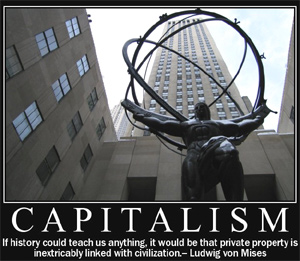
Capitalism: A True Love Story

Forbes.com | by Steve Forbes | October 19, 2009

How is wealth created? Seemingly a strange question for Forbes readers, but the question is hardly an academic one in the wake of the credit crisis and ensuing global recession. It has profound political implications that will affect our economic future.

Clearly, a sizable portion of the assets created in recent years turned out to be “make believe,” the result of an unsustainable, ephemeral bubble in housing and the churning out of increasingly exotic, ultimately toxic financial instruments. It’s one thing for folks and institutions that hold suspect paper to lose out, but it’s quite another when the process that created the stuff ends up undermining the global financial system and battering the lives of hundreds of millions of other people. [Read more…]

How Aaron Patzer of Mint.com Made $170 Million in Two Years

Inc.com | by Aaron Patzer | October 2009

Aaron Patzer launched Mint.com as a user-friendly alternative to Quicken and other personal-finance software out there. Little did he know that just two years later, Intuit, which makes Quicken, would fork over $170 million for his website. So how’d he do it? [Read more…]

Fix It – Even If It Ain’t Broke

FastCompany | by Kaihan Krippendorff | October 12, 2009

When something works, people grow fixated on it. They stop looking for alternative options. And this fixation creates an opportunity for those willing to reconsider the accepted approach. The company I introduced last week, Rosetta Stone (RST), hasn’t been satisfied with the fact that its products work. Instead, it continues to challenge the norm. [Read more…]

John Mackey of Whole Foods on Hiring Leaders

John Mackey of Whole Foods on Hiring LeadersInc.com | John Mackey Interview | July 2009

Q: What traits should I look for when hiring for a leadership position?

A: My philosophy about this has definitely evolved over the years. I understand people a lot better today than I did 30 years ago. Back then, I was more impressed with people who were very articulate. In many companies, the person who talks the best usually gets the job. I got snowed by a few of those people over the years. I still think communication is important, but I don’t think there’s always a correlation between being a great communicator and other virtues that make for a great leader. [Read more…]

In Defense of Capitalism

Capitalism Freedom Private PropertyFrontPage Magazine | by Vasko Kohlmayer | Sep. 18, 2009

“Capitalism is an evil, and you cannot regulate evil… you have to eliminate it and replace it with something that is good for all people,” concludes Michael Moore in his latest documentary Capitalism: A Love Story.

Moore’s fulmination is neither surprising nor atypical in this era when capitalism finds itself under all-out assault. Having become something of a derogatory term, capitalism gets faulted for almost every societal problem and ill. Blamed for exploitation, poverty, fraud, alienation, crime, racism and nearly everything else, capitalism is increasingly cast as the great villain of our time. [Read more…]

Warning Signs of Power Corruption in Organizations

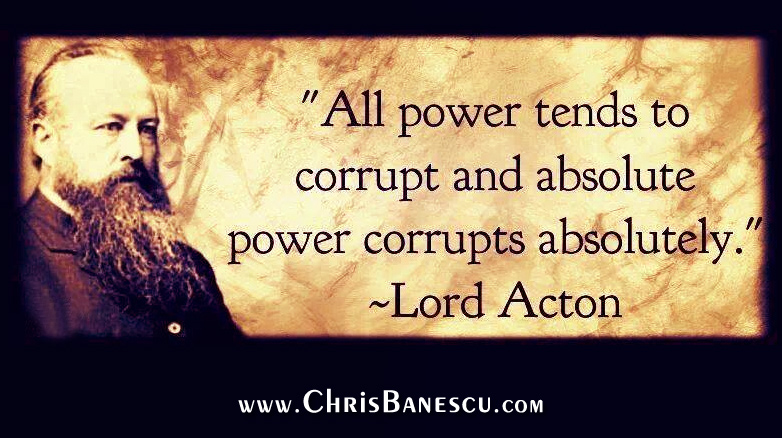
Power tends to corrupt, and absolute power corrupts absolutelyby Chris Banescu –
Power tends to corrupt, and absolute power corrupts absolutely. Great men are almost always bad men, even when they exercise influence and not authority: still more when you superadd the tendency or certainty of corruption by full authority. There is no worse heresy than the fact that the office sanctifies the holder of it. – Lord Acton

Lord Acton’s dictum, made in 1887, clearly warns us that the practice of wielding power and influence can corrode the character of leaders. History is replete with examples of individuals who wielded unchecked power and eroded not only their own integrity, but also the ethical and moral foundations of the organizations they led and brought them to catastrophe and ruin. This danger is true of all organizations including businesses, religious institutions, and governments.

Here is the risk inherent in leadership: The greater the leader’s power, wealth, authority, and influence, the more likely the leader could succumb to ethical lapses and moral failings. The risk increases if the organization has a culture that lacks financial or managerial transparency and accountability, has insufficient checks and balances on executive power, and discourages criticism from subordinates or members. When a leader with a poorly developed ethical or moral sense ends up leading an organization with a culture that prevents ethical self-examination, a slow but perfect storm starts to form that demands compromise from all levels of leadership and eventually leads to catastrophic consequences. [Read more…]